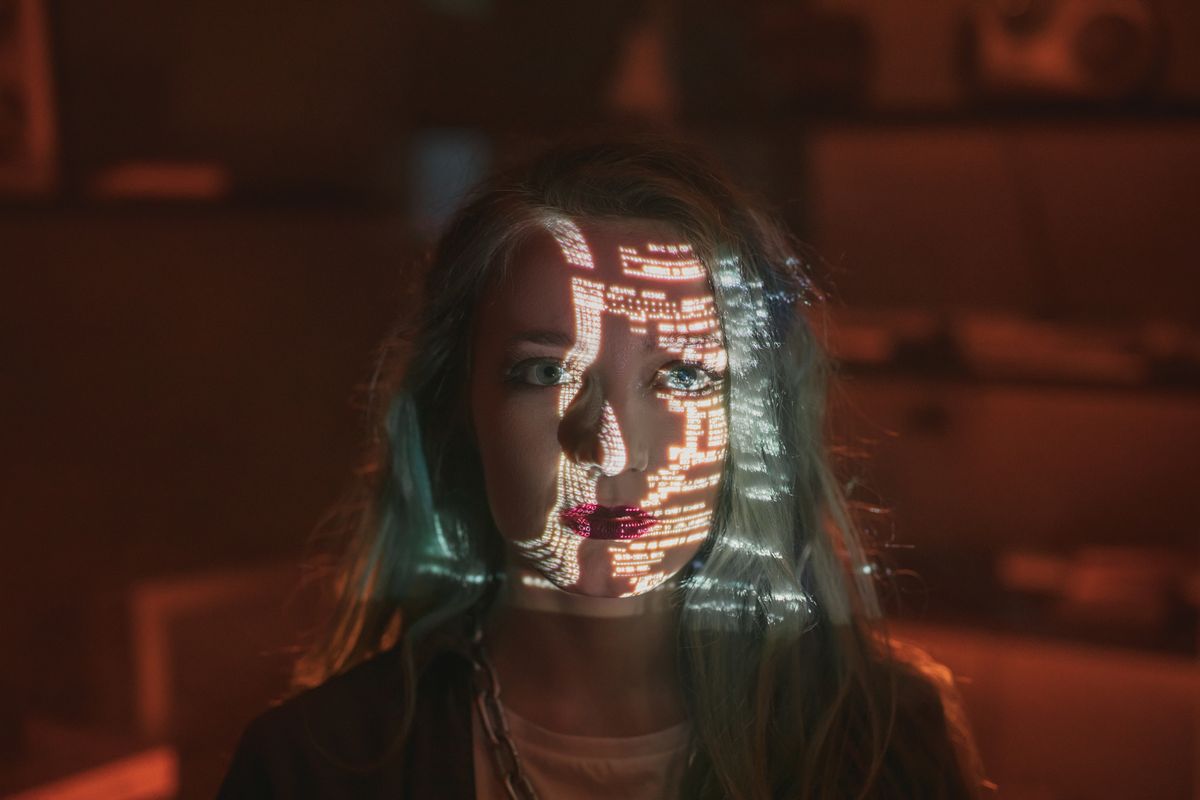
Video calls feel like the gold standard of online dating safety. You can see someone move, hear them speak, watch them react in real time — or so you think. In 2024, generative AI reached a point where synthetic faces can be animated in near-real-time using nothing more than a still photo and a consumer laptop. That shift has quietly changed the threat landscape for anyone meeting people online, and it is worth understanding how these tools work before your next video chat.
Deepfake video in a dating context almost always starts with a stolen identity. A scammer lifts a real person's photos from social media, feeds them into a face-swapping or full-face-generation tool, and then runs that synthetic layer over their own webcam feed during a call. What you see looks like a plausible human face — blinking, nodding, occasionally smiling. What you do not see is the person behind it. The goal is typically financial: build emotional trust over weeks, then introduce a crisis requiring money. Researchers who study romance fraud have documented cases where synthetic video was used for months before the victim realised anything was wrong.
The clearest real-time tell is edge behaviour around the face. Watch the hairline, ears, and jaw rather than the eyes. Deepfake models struggle with hair strands, earrings, and the precise boundary where skin meets background. When the person turns their head — especially past about 30 degrees to either side — the face can momentarily blur, smear, or produce a subtle warping at the cheek or ear. This happens because the AI is interpolating a face that was trained mostly on frontal images. Asking someone naturally and conversationally to turn their head to look at something off-camera is one of the simplest stress tests you have.
Lighting transitions expose synthetic faces more than almost anything else. Ask the person to move toward a window or switch on a lamp during the call. Real skin reflects light with subtle, irregular variation — pores, fine lines, tiny shadows under the nose. AI-rendered faces tend to look slightly waxy or uniformly smooth under new lighting, and the shadow edges on the nose and chin often lag behind or fail to update convincingly. This is not about looking perfect versus looking imperfect; it is about the specific, unnatural smoothness that current models produce when light angles change quickly.
Audio and lip synchronisation is another pressure point. In low-latency deepfake rigs, the mouth movements are generated to match the scammer's speech, but the synchronisation degrades when consonants involve rapid jaw movement — the letters B, P, M, and F are particularly revealing. Watch the lower lip and chin closely during a sentence with lots of those sounds. A very slight delay between what you hear and what the face does, or an unnaturally stiff lower jaw, can signal a synthetic overlay. Switching to a topic that makes the person laugh is useful here too, because genuine laughter involves the whole face and neck in ways that current models handle inconsistently.
Texture and teeth are often overlooked. AI face models historically struggled with teeth — they can appear blurred, unnaturally uniform, or briefly glitch when the mouth opens wide. The same applies to the whites of the eyes, which can occasionally look slightly flat or oddly luminous compared to natural scleral coloration. These are not perfect diagnostics, because video compression also degrades these features, but they become meaningful when you see them alongside other anomalies on a call that is otherwise high-quality.
Beyond watching the video itself, think about behavioural patterns around calls. Someone running a deepfake rig cannot easily share their screen, hold up an object with text written on it, or perform spontaneous requests that require physical interaction with their environment. You can ask casually — 'Can you show me your bookshelf?' or 'I love your lamp, can you move it closer?' These requests are normal things people do on video calls, and a genuine person does them without hesitation. Persistent refusals, sudden technical problems exactly when you make these requests, or a suspiciously static background should raise your attention.
Platform-level verification matters here more than individual instinct, because even trained observers can be fooled. SafeDate AI uses live video selfie matching against government-issued ID as part of its verification process, which is designed precisely to catch the gap between a stolen face and the person actually holding the device. If someone's profile carries a verified badge from that kind of process, it does not mean they are a perfect romantic match, but it does mean a human being presented consistent identity documents in real time — something a deepfake session cannot replicate. Verification layers like these do not eliminate the need for your own awareness, but they meaningfully reduce your exposure.
Reverse image search remains a useful first step before a video call even happens. Run the profile photos through Google Images or a dedicated tool like TinEye. If the images appear on multiple unrelated accounts, stock-photo sites, or social media profiles with different names, that is a serious warning sign. Synthetic faces generated by tools like StyleGAN often lack matching social media histories, appear in very limited contexts, or have an eerie visual perfection — symmetrical features, skin with no distinguishing marks, ears that look slightly too regular. When a profile photo makes you feel like you are looking at a magazine rather than a person, trust that instinct enough to look harder.
It is also worth knowing that not every suspicious video call involves a deepfake. Some fraudsters use pre-recorded clips, cutting away when you ask them to do something unscripted, or claim the camera is broken and insisting on audio only. These older techniques are still common and should be taken just as seriously. The rule of thumb is consistent: real people on legitimate calls can engage spontaneously with your requests, are not bothered by you asking them to do small, natural things, and do not disappear every time the connection is 'too good to fail' technically.
None of this is meant to make online dating feel like an interrogation. The overwhelming majority of people on dating platforms are exactly who they say they are, trying to connect genuinely. But spending five minutes learning these signals — edge warping on head turns, lighting inconsistencies, lip-sync lag, the teeth and eye test, and behavioural reluctance around spontaneous requests — gives you a practical toolkit that works in real time, without needing any special software. Awareness is still the most portable protection you have, and it costs nothing to use it.